
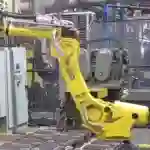


Precision and consistency have become essential requirements for modern manufacturing. Companies are increasingly adopting customized automation to improve production quality, reduce process variations, and achieve higher output. Robomatics Automation is a specialized industrial automation solutions provider and one of the Special Purpose Machine Manufacturers focused on developing customized machinery and automation systems for specific industrial applications. Its capabilities include special purpose machines, robotic automation, fixture design, machine tending, material handling, robot programming, and system integration.
The Growing Need for Customized Machinery
Traditional manufacturing equipment may not always be suitable for every production requirement. A component may have a unique geometry, a process may require multiple operations, or a manufacturer may need to achieve a specific cycle time that cannot be easily achieved using standard machinery.
Special purpose machines provide an alternative by being developed around the exact requirements of a particular application.
Instead of purchasing a general-purpose machine and adapting the production process, manufacturers can work with Special Purpose Machine Manufacturers to develop equipment specifically suited to their production needs.
How SPMs Improve Manufacturing Precision
Precision depends on several factors, including component positioning, machine movement, tooling, fixtures, process parameters, and operator consistency.
A customized SPM can control these factors through automated sequences and dedicated mechanisms.
For example, an SPM designed for component assembly can automatically position parts before the assembly operation. Similarly, a machining SPM can use customized fixtures and tooling to maintain consistent component positioning.
Automating these activities can help minimize variations between production cycles.
SPMs and Quality Control
Quality control is another important area where customized automation can provide value.
An automated production machine can incorporate sensors, measurement devices, cameras, and inspection systems to monitor process parameters or identify potential defects.
Depending on the application, an SPM can be designed to:
- Check component dimensions
- Verify component presence
- Detect incorrect positioning
- Perform automated inspection
- Separate rejected components
- Record production information
- Monitor process conditions
Integrating inspection capabilities directly into the production process can help manufacturers identify issues earlier.
Dedicated Machines for Repetitive Operations
Repetitive production operations can consume significant amounts of time and manpower. These processes may include pressing, drilling, fastening, assembly, welding, loading, unloading, and inspection.
A dedicated machine can perform these operations according to a programmed sequence.
This can help manufacturers achieve consistent production cycles while reducing the physical burden of repetitive work on operators.
The objective is not necessarily to eliminate human involvement but to allow employees to focus on activities that require decision-making, supervision, quality management, and other higher-value responsibilities.
Customized Fixtures and Workholding
Workholding is a critical part of many SPM applications.
A component must remain stable and correctly positioned during machining, welding, assembly, or inspection. A poorly designed fixture can create positioning problems and affect the performance of the entire production system.
Professional fixture design considers factors such as:
- Component geometry
- Clamping requirements
- Accessibility
- Loading and unloading
- Production cycle time
- Required accuracy
- Machine movement
- Operator access
- Robotic interaction
Robomatics Automation also provides fixture design capabilities, allowing fixtures to be incorporated into broader automation projects.
Connecting SPMs With Industrial Robots
Industrial robots can extend the capabilities of special purpose machines.
A robot can load raw components into an SPM, remove completed parts, transfer components between machines, or perform additional operations.
For example, a robotic cell may include:
Robot → Fixture → SPM → Inspection → Finished-Part Handling
This type of integrated setup can automate multiple stages of a production process.
Robotic integration is particularly useful where manufacturers require continuous production, consistent handling, or reduced manual intervention.
Applications Across Manufacturing Industries
Special purpose machines can be customized for numerous industrial sectors.
Automotive Components
Automotive manufacturers often require high-volume production with consistent quality. SPMs can support assembly, machining, welding, inspection, and handling operations.
Industrial Engineering
Engineering companies can use customized machines for component processing, assembly, drilling, tapping, testing, and inspection.
Fabrication
Automated fixtures, welding systems, and robotic cells can support repetitive fabrication processes.
Electrical and Electronics
Specialized machines can assist with assembly, testing, inspection, and component handling where accuracy is important.
General Manufacturing
Any manufacturing operation involving repetitive and clearly defined processes can potentially benefit from customized automation.
Key Factors Before Investing in an SPM
Before approaching Special Purpose Machine Manufacturers, businesses should clearly define the production problem they want to solve.
Important information includes:
Current Cycle Time: Understanding the existing cycle time helps establish realistic automation goals.
Production Volume: Higher production volumes may provide stronger justification for dedicated automation.
Quality Issues: Identifying current quality problems can help determine the required machine features.
Manual Operations: Repetitive or physically demanding tasks are often suitable candidates for automation.
Component Specifications: Dimensions, weight, material, and geometry influence machine design.
Future Requirements: The machine should ideally accommodate foreseeable production changes.
Industry 4.0 and Intelligent SPMs
Industry 4.0 technologies are changing the design of modern production equipment. Special purpose machines can now incorporate sensors, data collection, machine monitoring, PLC systems, HMIs, and connectivity features.
These technologies can provide manufacturers with greater visibility into production performance.
Depending on the system, manufacturers may be able to monitor:
- Machine status
- Production count
- Cycle time
- Downtime
- Error conditions
- Process parameters
- Maintenance requirements
Such information can help production teams identify bottlenecks and make better decisions.
Why Robomatics Automation?
Robomatics Automation provides customized industrial automation solutions for manufacturers looking to improve their production processes. The company's expertise includes Special Purpose Machines, robotic automation, fixture design, machine tending, material handling, robot programming, and system integration.
By bringing different automation capabilities together, the company can help manufacturers develop solutions that address specific production challenges.
Its application-focused approach is suitable for businesses that require customized equipment rather than standard off-the-shelf machinery.
Moving Toward Smarter Manufacturing
Manufacturing is increasingly moving toward automation that is precise, connected, and application-specific. Special purpose machines can provide a practical way to automate operations that are repetitive, time-consuming, or difficult to perform consistently manually.
When combined with robotics, sensors, customized fixtures, and intelligent controls, SPMs can become an important part of a modern automated production environment.
Conclusion
Special Purpose Machine Manufacturers help businesses develop customized machinery that addresses specific production requirements. From improving component positioning and process consistency to integrating robotics and inspection systems, SPMs can support manufacturers in achieving greater production efficiency.
The success of an SPM project depends on proper application analysis, machine design, automation integration, fixture development, safety considerations, and technical support.
Robomatics Automation offers customized industrial automation and special purpose machine solutions designed around individual manufacturing applications.
Looking to improve precision, productivity, or automation in your manufacturing process? Contact Robomatics Automation today to discuss your application and explore a customized SPM solution.
Frequently Asked Questions
1. What makes a Special Purpose Machine different from standard machinery?
An SPM is specifically designed for a defined production operation or application, while standard machinery is generally intended for a broader range of tasks.
2. Can SPMs improve production quality?
Yes. Automated positioning, controlled movements, dedicated fixtures, sensors, and inspection systems can help improve process consistency and reduce variations.
3. Can an SPM include inspection systems?
Yes. Depending on the application, cameras, sensors, measurement devices, and automated quality checks can be incorporated into an SPM.
4. Does Robomatics Automation provide customized SPM solutions?
Yes. Robomatics Automation provides customized special purpose machines along with robotic automation, fixture design, machine tending, material handling, and system integration capabilities.
Author Bio
Author – Industrial Automation Content Specialist
The author writes about industrial automation, robotics, special purpose machines, manufacturing technologies, and engineering solutions, helping manufacturers understand practical technologies for improving productivity, precision, and production efficiency.
#SpecialPurposeMachine #SpecialPurposeMachineManufacturers #SPM #IndustrialAutomation #ManufacturingTechnology #RoboticAutomation #IndustrialRobotics #AutomationSolutions #SmartManufacturing #RobomaticsAutomation