

Lithium-Sulfur Battery Market Set for Rapid Expansion as High Energy Density and Sustainable Materials Accelerate Adoption
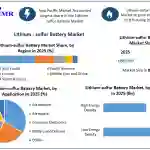
The global Lithium-Sulfur Battery Market is entering a high-growth phase as demand rises for lightweight, high-energy-density, and cost-effective energy storage technologies across electric mobility, aerospace, defense, consumer electronics, and stationary energy storage. According to Maximize Market Research, the global Lithium-Sulfur Battery Market was valued at USD 0.39 billion in 2023 and is expected to grow at a CAGR of 31.8% from 2024 to 2030, reaching nearly USD 2.69 billion by 2030. The market is benefiting from the transition toward cleaner energy technologies, increasing electric vehicle adoption, government zero-carbon initiatives, and growing demand for batteries capable of delivering greater energy with lower weight.
* Download the Full Market Report: https://www.maximizemarketresearch.com/request-sample/226050/
Market Estimation, Growth Drivers and Opportunities
High energy density remains one of the strongest growth drivers for lithium-sulfur batteries. Compared with conventional lithium-ion technologies, Li-S chemistry offers the potential for substantially higher specific energy while using sulfur, an abundant and relatively low-cost material. This combination is particularly attractive for applications where battery weight directly influences operating performance, including aircraft, drones, satellites, electric vehicles, and portable electronics. Increasing environmental concerns are also supporting adoption because lithium-sulfur batteries can reduce reliance on several critical and expensive materials used in conventional battery chemistries. Continued research into sulfur cathodes, lithium-metal anodes, electrolytes, solid-state configurations, and improved cycle life is creating additional opportunities. The expansion of microgrids and renewable energy infrastructure also presents an opportunity for lithium-sulfur technology to serve emerging stationary storage requirements.
U.S. Market Trends and Investment
The United States is becoming an important innovation and manufacturing hub for lithium-sulfur batteries, supported by demand from aerospace, defense, drones, electric mobility, and domestic battery supply-chain initiatives. In February 2025, Lyten announced agreements to secure domestically sourced sulfur for its U.S. lithium-sulfur manufacturing facilities in California and its planned Nevada gigafactory, reinforcing its strategy to reduce dependence on foreign-controlled battery minerals. In May 2025, Lyten also launched a dedicated drone-propulsion initiative using American-made lithium-sulfur batteries and allocated manufacturing capacity to defense, UAV, and satellite applications. Meanwhile, U.S.-based Sion Power advanced commercialization through a new large-format battery production line in March 2025 and subsequently introduced a vacuum-deposition process for ultra-thin lithium-metal anodes in September 2025. These investments demonstrate growing U.S. interest in domestic next-generation battery technologies and high-performance applications.
Market Segmentation: Largest-Share Segments
By application, the Aerospace segment represents a dominant area of the Lithium-Sulfur Battery Market. The segment benefits from the technology's high energy-density characteristics and lightweight design, which are particularly valuable for aircraft, drones, satellites, and other aerospace platforms where reducing battery mass can increase flight endurance and payload capability. The growing use of unmanned aerial vehicles and high-altitude aircraft is expected to strengthen demand further.
By energy density, the High Energy Density segment represents the key growth category. High-energy-density batteries can provide longer operating durations while occupying less space and weight, making them attractive for electric vehicles, aerospace systems, and energy storage applications. By battery capacity, the Below 500 mAh segment is an important category driven by demand for compact batteries used in wearable devices, medical equipment, wireless communication products, and other miniaturized electronics.
Lithium-sulfur Battery Key Players:
1. Bettergy Corp. (Peekskill, New York.)
2. TRU Group Inc. (Tucson, Arizona, United States)
3. Zeta Energy LLC (Houston, Texas )
4. CIC energiGUNE (Vitoria, Álava.)
5. Giner Inc. (Newton, Massachusetts, US.)
6. Gelion Technologies Pty Ltd. (Australasia)
7. Theion (Germany)
8. Ilika PLC (UK )
9. Poly Plus Battery Co. (Berkeley, CA,)
10. Iolitec Ionic Liquids Technologies GmbH (Germany)
11. Lyten Inc. (San Jose, California)
12. Merck KGaA (Darmstadt, Germany.)
13. LG Chem Ltd. (Seoul, South Korea.)
14. Rechargion Energy Pvt. Ltd. (Pune, Maharashtra.)
15. Shenzhen Uscender Industrial Co. Ltd. (China)
16. Sion Power Corp. (United States)
17. Solid State PLC (Redditch, UK)
18. VTC Power Co. Ltd. (shenzhen)
19. Guang Dong Fullriver Industry Co. Ltd. (Guangdong)
20. NexTech Batteries (Carson City, Nevada)
21. Li-S Energy Ltd.
Competitive Analysis
The competitive landscape includes technology developers, battery manufacturers, and advanced-material companies working to improve energy density, cycle life, charging performance, safety, and manufacturability.
Zeta Energy LLC is developing lithium-sulfur technology designed to eliminate dependence on nickel and cobalt while improving battery performance. Its collaboration with Stellantis is targeting lithium-sulfur batteries for electric vehicles, with commercial deployment planned toward the end of the decade.
Lyten Inc. is one of the most active U.S. lithium-sulfur developers, combining sulfur chemistry with its 3D graphene technology. In 2025, the company expanded U.S.-sourced sulfur procurement and focused on lightweight batteries for drones and national-security applications. Its subsequent acquisition of major Northvolt assets further strengthened its manufacturing ambitions.
Theion of Germany is developing sulfur-based batteries for mobile and automotive applications. Its focus on high capacity, rapid charging, and lower-cost materials positions it as a European technology participant in the emerging Li-S ecosystem.
Gelion Technologies has advanced sulfur-based cathode technology through partnerships and government-supported development. In 2025, Gelion transferred advanced sulfur cathode-material technology from the Max Planck Institute into its own operations and secured UK government DRIVE35 funding with QinetiQ to scale and validate lithium-sulfur pouch cells.
Sion Power Corp. remains a significant U.S. battery technology developer with a history in lithium-sulfur research. In 2025, it strengthened commercialization of its lithium-metal platform through a large-format production line and advanced lithium-metal anode manufacturing, supporting the broader development of high-energy battery architectures.
Regional Analysis
China remains strategically important to the global battery ecosystem because of its extensive battery manufacturing capabilities and materials supply chain. Japan is supported by government efforts to accelerate electric vehicle adoption and advanced battery technologies. Germany benefits from its strong automotive industry and research ecosystem, including companies developing sulfur-based batteries. France can benefit from Europe's broader push toward battery localization and sustainable mobility. The UK has developed a supportive innovation environment through programs such as DRIVE35 and the wider battery innovation ecosystem, which has helped advance lithium-sulfur research and commercialization. The United States is rapidly strengthening its position through domestic battery manufacturing, defense applications, aerospace demand, and efforts to establish resilient critical-mineral supply chains. MMR identifies Asia Pacific as the dominant regional market, with China, Japan, and South Korea playing pivotal roles.
Related Reports:
Global Biogas Market Report https://www.maximizemarketresearch.com/market-report/global-biogas-market-report/193697/
Portable Power Station Market https://www.maximizemarketresearch.com/market-report/portable-power-station-market/193799/
Global Crude Oil Flow Improvers Market https://www.maximizemarketresearch.com/market-report/global-crude-oil-flow-improvers-market/28804/
Conclusion
The Lithium-Sulfur Battery Market is positioned for substantial expansion as industries seek alternatives to conventional lithium-ion batteries that can provide higher energy density, lower weight, and reduced dependence on critical minerals. The projected 31.8% CAGR through 2030 highlights the scale of the opportunity. Aerospace and high-energy-density applications are likely to remain particularly attractive in the near term, while electric vehicles, drones, defense systems, consumer electronics, and stationary storage can create additional demand. In my view, the most important market opportunity will come from overcoming cycle-life, safety, and manufacturing-scale challenges. Companies that successfully combine sulfur-based materials with advanced cathodes, lithium-metal protection, improved electrolytes, and scalable manufacturing will be best positioned to accelerate commercial adoption and shape the next generation of high-performance batteries.
About Maximize Market Research
Maximize Market Research Pvt. Ltd. (MMR) is a global market research and consulting firm known for delivering accurate, actionable, and data-driven insights. Our expertise spans diverse industries — including medical devices, pharmaceuticals, technology, automotive, electronics, chemicals, personal care, and consumer goods. We provide services such as market-validated forecasts, competitive intelligence, strategic consulting, and industry impact analysis, helping businesses navigate market complexities and achieve sustainable growth.
Contact Maximize Market Research
MAXIMIZE MARKET RESEARCH PVT. LTD.
2nd Floor, Naval IT Park Phase 3,
Pune-Bangalore Highway, Narhe,
Pune, Maharashtra 411041, India.
📞 +91 9607365656
📧 [email protected]